
Hacienda delivered the 2027 economic package to Congress on September 8. As Expansión reported, Secretary Édgar Amador Zamora’s proposal includes no new taxes and no increases to existing ones. The revenue measures go after collection instead: wider IVA withholding by digital platforms, adjusted ISR withholding on sales through technology platforms and changes to the income tax law aimed at the “factureras” that sell fake invoices.
The same day, President Sheinbaum said a Ley de Economía Digital would go to Congress to reduce the use of cash gradually, with deadlines for the move to electronic payments and support for micro and small businesses to adopt digital collection. According to Expansión’s reading of the bill, it would let Hacienda name strategic sectors where payments can only be digital, with gas stations and toll booths mentioned as likely first candidates. Cards, transfers, SPEI, CoDi and DiMo would all count. The bill still has to pass, and the sectors haven’t been named.
Whatever happens to the bill in Congress, both announcements push the same way. A growing share of what Mexican companies sell will be paid through channels that leave a record at the bank, next to the CFDIs the SAT already receives. Our view is that the companies that fare well under this will be the ones whose payments and CFDIs match without someone doing it by hand at the end of every month.
Why matching is harder than it looks
Reconciling a payment with an invoice sounds like a lookup, where a customer pays and the invoice for the same amount gets marked as paid. In practice the two sides rarely line up that neatly, and the reasons are structural:
- A card acquirer deposits a day’s sales as one amount, net of its commission, so one bank line covers many sales.
- A marketplace or delivery platform pays out net of its fees and of the IVA and ISR it withheld, on its own schedule.
- A business customer pays three invoices with one transfer, or one invoice in two transfers.
- A transfer’s concept field says whatever the sender typed, which may be an invoice folio, a nickname or nothing at all.
- Sales to the general public are covered by a global invoice for a day, a week, two weeks or a month, so individual payments have no invoice of their own.
The tax rules add a second layer. An invoice issued with the payment method PPD (paid in installments or later) needs a CFDI with the payment complement for each payment received, issued by the fifth day of the following month. That complement can’t be issued correctly until someone knows which deposit paid which invoice and how much of it. A company that reconciles once a month, by hand, in the last week, is always close to that deadline.
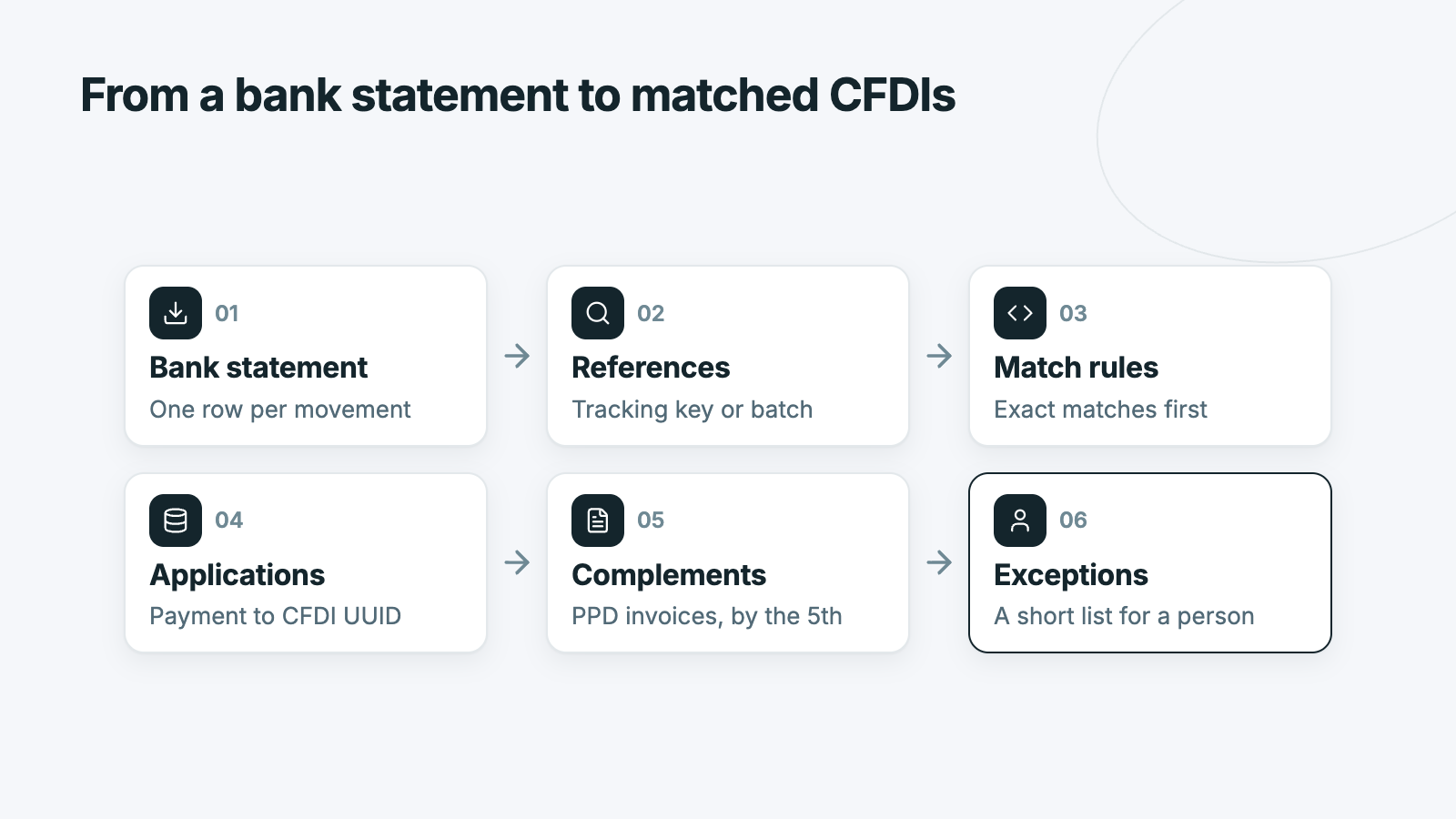
None of those cases needs tax expertise to solve. They need data that’s shaped for matching. In the work we’ve done with invoice data for an ERP software vendor in Mexico, the tables for purchase invoices and CFDIs appeared in nearly every one of the 62 customer databases we compared. The invoices themselves are usually well structured. What usually isn’t there is the link between a bank movement and the documents it settles.
That link is worth modeling explicitly. A payment is one row per bank movement, with its date, its gross and net amounts and whatever reference came with it (the clave de rastreo of a SPEI transfer, the acquirer’s batch ID, the platform’s payout ID). An invoice is one row per CFDI, keyed by its UUID, with its total, its payment method and how much is still unpaid. Between them sits a table of applications: this payment covered this much of that invoice, matched by this rule, confirmed by this person or by the system. Fees and withholdings get their own rows, so a net card deposit can be shown to add up to the gross sales it came from.
With that in place, most of the matching can run on rules, in order of confidence:
- An exact reference (an invoice folio or UUID in the concept field) with an equal amount.
- A known customer account plus an amount that equals one open invoice or a combination of a few.
- A card or platform deposit whose gap from that day’s sales matches the expected fees and withholdings.
- Everything else goes to a queue for a person, with the closest candidates already listed.
The queue is the part that pays for the effort. Instead of a month of statements to reconcile, someone gets a short list of deposits with no invoice and invoices with no payment, and each one means something: a sale that wasn’t invoiced, a receivable that’s late, a fee that changed, a deposit that wasn’t a sale at all.
Start before the law does
A company doesn’t need to wait for the Ley de Economía Digital to pass, or for Hacienda to name its sector, to start on this. The work is the same either way, and it gets harder the longer the history of unmatched movements grows. We’d begin by exporting three months of bank statements and the CFDIs issued in the same period, then counting how many deposits match an invoice on amount and reference alone. That number says how much of the job can be automated today and how much depends on getting customers and platforms to send better references.
Congress will debate the package over the coming weeks, and the details of the cash law will change on the way. Whatever comes out of it, a company whose payments already match its invoices will mostly need to adjust its matching rules, while one that reconciles by hand will need more hours at the end of each month.